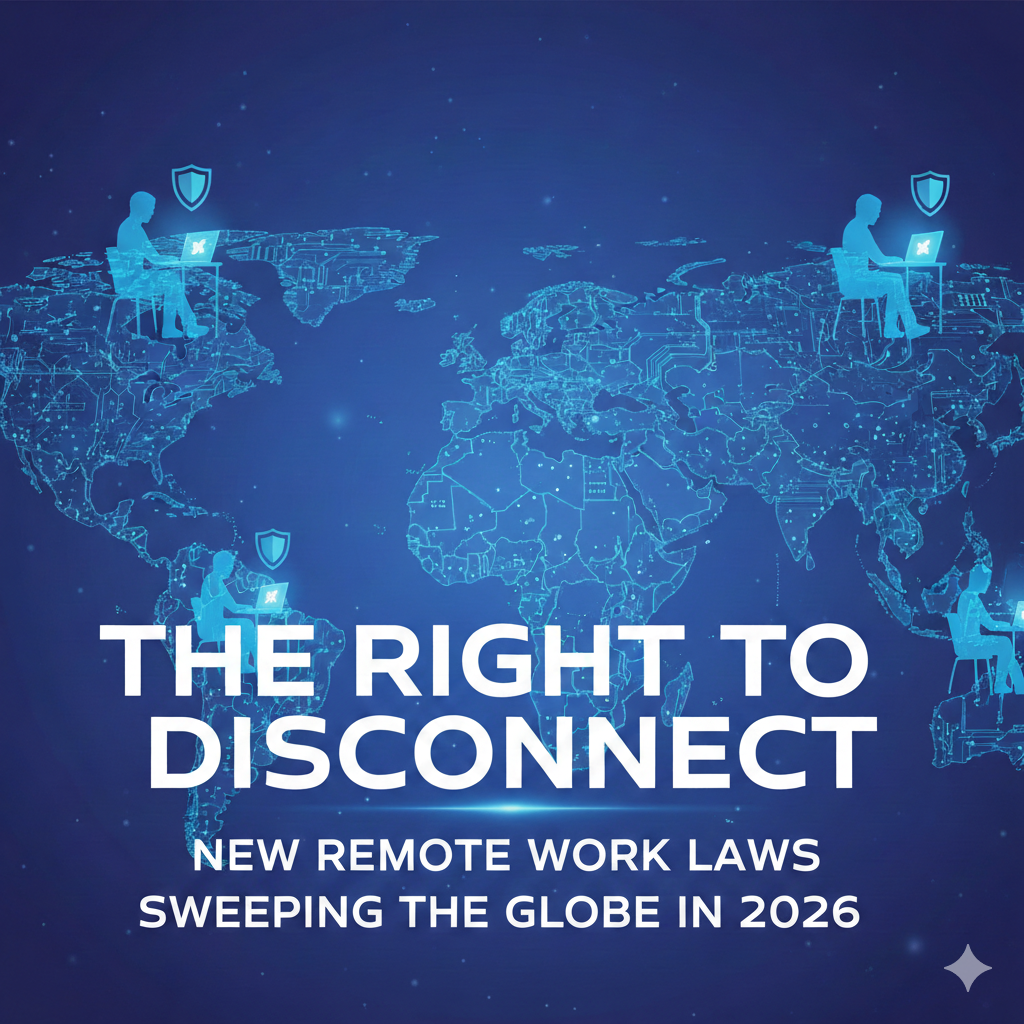
The Right to Disconnect: New Remote Work Laws Sweeping the Globe in 2026
📵 Silence is Golden (and Legal)
Before 2020, bringing work home was an exception. After 2020, it became the rule. By 2024, the lines became so blurred that "Home" ceased to exist; there was only the "Remote Office," a place where the Slack notification sound followed you into the kitchen, the bathroom, and the bedroom.
But the pendulum is finally swinging back. Governments have stepped in to reclaim the evening.
This year marks the tipping point for Remote Work Laws, specifically the "Right to Disconnect." It is causing panic in boardrooms, relief in living rooms, and a fundamental rewriting of the employment contract across the Western world.
📜 What Does the Law Actually Say?
The legislation varies by country, but the core principles of the 2026 Global Standard (adopted by the EU, UK, Australia, and Canada) are consistent:
1. The Prohibition: Employers are legally banned from penalizing employees who refuse to answer calls, emails, or Slack messages outside of their contractually agreed hours.
2. The Fines: The teeth of the law are sharp.
* Australia: Up to $18,000 AUD per individual breach.
* France: Fines proportional to company revenue (up to 1% of turnover).
* Portugal: Managers can face personal liability for harassment.
3. The Burden of Proof: It is on the employer to prove the contact was a genuine "emergency," not on the employee to justify ignoring it.
🇺🇸 The US lags, but catches up
While Europe led the charge, 2026 is the year the US officially woke up.
* California Assembly Bill 2026: Dubbed the "Weekend Act," it mandates that any salaried employee earning under $150k must be compensated at 1.5x overtime rates for after-hours availability. This kills the concept of "always-on" salary work.
* New York: Is debating a "Do Not Disturb" bill that would allow employees to sue for harassment if contacted after 8 PM repeatedly.
> "Burnout is not a badge of honor. It is a drain on the national economy," says the US Labor Secretary. "We are working people to death in their own pyjamas. It stops now."
🏢 The Corporate Response: "Scheduled Send"
To avoid fines, companies like Google, Microsoft, and Salesforce have updated their enterprise software to force compliance. It is no longer just policy; it is code.
* The 'Hard Cap': If a manager writes an email at 9:00 PM, the system *auto-schedules* it. It will not be delivered to the employee's inbox until 9:00 AM the next business day. The server literally holds the mail.
* The Loophole: Multinational teams. A manager in London (9 AM) emailing a worker in New York (4 AM) creates a timezone nightmare that corporate lawyers are still untangling. "Global" teams are becoming legally expensive and logistically complex.
🌍 The Nomad Visa War
Another side effect of these laws is the explosion of Digital Nomad Visas. Since remote work is now codified, countries are fighting to tax your income.
* Spain & Italy: Are offering 0% tax for the first 5 years if you move your remote job to their rural villages.
* Japan: Launched the "J-Nomad" visa to repopulate its countryside with tech workers.
* The Catch: You have to prove you are employed by a company that respects the "Right to Disconnect" laws of your home country.
🧠 Mental Health vs. "Hustle Culture"
Not everyone is celebrating. Startups and "Finance Bros" hate it.
"Innovation doesn't strictly happen between 9 and 5," argues a prominent Silicon Valley VC. "If we stop hustling, we lose to China."
Critics claim these laws will make Western nations rigid and less competitive. However, early data from the UK pilots shows that productivity actually increased by 15% when workers were guaranteed 12 hours of uninterrupted silence a day. A rested brain works faster.
🏁 Conclusion: Reclaiming the Soul
The Remote work laws of 2026 are a necessary correction to a decade of digital intrusion. We are relearning a simple truth: Rest is productive. A worker who is never 'offline' is a worker who is slowly burning out.
2026 is the year we put borders back on the map of our lives. The laptop closes at 5. And that is the law.
❓ Frequently Asked Questions (FAQ)
Can my boss fire me for not answering the phone on Saturday?
Under the new laws in protected jurisdictions (UK, EU, AUS, CA, NY), **No**. It would be considered "Unfair Dismissal" and grounds for a massive lawsuit. The onus is on them to prove the building was burning down.Does this apply to freelancers?
Generally, no. Freelancers are independent business owners. However, gig economy platforms (Uber, DoorDash) are facing separate regulations regarding "Digital Control" and algorithmic pressure. If an app punishes you for logging off, it is now illegal.What qualifies as an emergency?
The law defines an emergency strictly: A situation threatening the physical safety of persons, or significant/irreversible financial damage to the business (e.g., a server farm on fire, or a cyberattack in progress). A missed deadline due to poor planning is not an emergency.About the Author

Elena Corves
Dr. Elena Corves is a former Wall Street quantitative analyst who now leads the Business & Economy desk at Global Brief. She is a renowned voice on the 'End of Cash' transition, Central Bank Digital Currencies (CBDCs), and the emerging fractional gig economy. Elena's writing cuts through the jargon of high finance to reveal the human impact of macroeconomic trends. She is particularly focused on the rise of fintech in developing markets and the shifting dynamics of global trade routes. She holds a PhD in Economics from the London School of Economics.
Global Brief Intel
Source:
Continue Reading

Africa Fintech Boom: The Wakanda Effect in 2026
Nigeria's Flutterwave becomes the continent's first 'Decacorn' ($10B+ valuation) after IPO.

Amazon 'Prime Air' Goes Global: Drone Delivery Launches in 50 Cities
Amazon has officially expanded its Prime Air drone delivery service to 50 major metropolitan areas worldwide, including London, Tokyo, and New York.
The $25,000 EV War: How Tesla and BYD Are Flooding the Market in 2026
Tesla officially launches the highly anticipated 'Model 2' (Code Name: Redwood) at a base price of $24,990, finally reaching price parity with the Toyota Corolla.