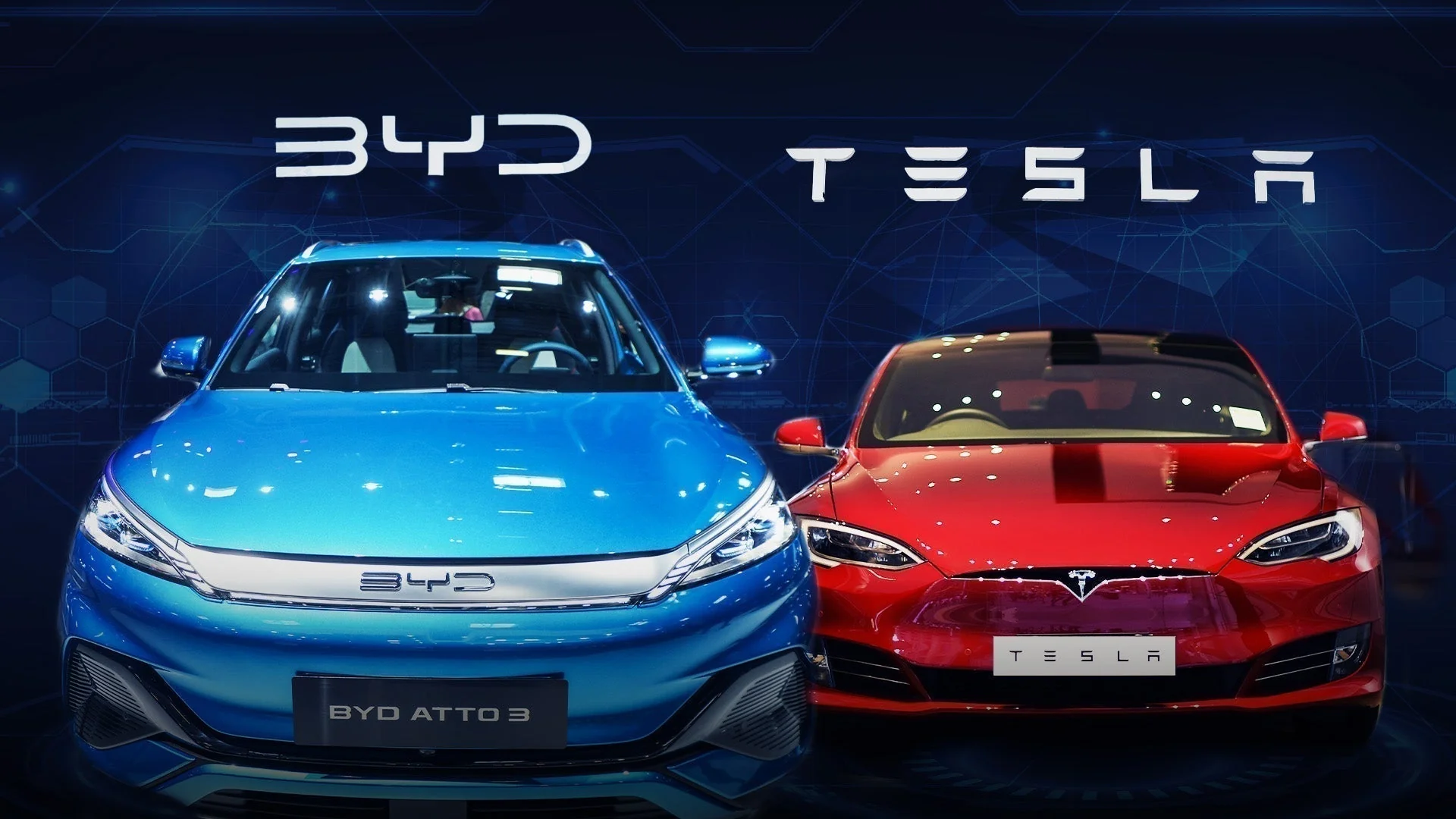
The $25,000 EV War: How Tesla and BYD Are Flooding the Market in 2026
🚗 The Race to the Bottom (Price)
For the last 15 years, the electric car was a status symbol.Driving a Tesla or a Lucid was a flex. It was a toy for the rich in California and Norway, a signifier that you cared about the planet—and that you could afford a $60,000 luxury sedan.
But 2026 will be remembered by automotive historians as the year the status symbol died and the global commodity was born.
We are currently witnessing the opening shots of the $25,000 EV War. This is the holy grail number—the critical price point where an electric car becomes cheaper upfront than a Honda Civic or Toyota Corolla, without needing any government subsidies or tax credits.
It is no longer about "Saving the Planet"; it's about saving the wallet. The economics have finally eclipsed the ideology.
🥊 The Main Event: Tesla vs BYD
The market is no longer fragmented. It has consolidated into a massive duopoly. Two titans are battling for the soul of the mass market, and they have very different strategies to win your driveway.
1. The Defender: Tesla Model 2 (Project Redwood)
After years of rumors, delays, and "Master Plans," Elon Musk finally unveiled the compact Tesla at Giga Mexico. It is not just a smaller Model 3; it is a manufacturing revolution.* The Price: $24,990 (Base trim, before taxes).
* The Range: 280 miles (EPA estimated).
* The Secret Weapon: "Unboxed" Manufacturing. Unlike traditional cars built on a linear assembly line, Tesla casts the entire front and rear underbodies in massive 9,000-ton Gigapresses. The car is assembled in parallel "modules" that snap together like Lego bricks, cutting the factory footprint by 40% and production cost by 50%.
* The Vibe: Minimalist to the extreme. No stalks, no buttons, no dashboard cluster. Just a central screen, a steering wheel, and four wheels. Critics call it "barren"; buyers call it "future-proof."
2. The Challenger: BYD Dolphin MAX
The Chinese giant Build Your Dreams (BYD) isn't playing nice. Having conquered the Chinese domestic market, they are aggressively expanding into Europe, South America, and Southeast Asia.* The Price: $19,500 (in Asia), $23,000 (US/EU after tariffs).
* The Range: 310 miles (WLTP).
* The Secret Weapon: Vertical Integration. BYD is unique because they own the entire supply chain. They own the lithium mines in Chile, the factories that make the batteries, the ships that transport the cars (`BYD Explorer No. 1`), and the insurance company that insures them. No company on Earth can manufacture hardware cheaper than BYD.
* The Vibe: Quirky, bio-design, and feature-rich. It comes with a rotating screen, built-in karaoke functionality, and plush vegan leather seats standard. They are winning by offering *more* for *less*.
🔋 The Tech: How Did Batteries Get So Cheap?
The hero of 2026 is not a CEO; it's a chemical formula.
In 2021, battery costs were hovering around $150/kWh. Today, they have crashed to $45/kWh.
This collapse in cost is driven by two new chemistries that have replaced the expensive Nickel-Cobalt batteries of the past:
1. LFP (Lithium Iron Phosphate)
Used by Tesla. These batteries use widespread, cheap iron and phosphate. * **Pros:** Virtually indestructible. They are non-flammable (no thermal runaway) and can last for 1 million miles (4,000 charge cycles). You can charge them to 100% every day without degradation. * **Cons:** Heavier than nickel batteries, meaning slightly less range per pound.2. Sodium-Ion (Na-Ion)
Used by BYD. This is the game-changer for 2026 city cars. * **The Innovation:** They replace Lithium with Sodium—literally table salt ($NaCl$). Salt is abundant and costs almost nothing. * **The Impact:** While they hold less energy than lithium, they charge incredibly fast and work perfectly in freezing -20°C weather, solving the "cold weather range anxiety" problem.📉 The Casualties: Legacy Auto's Crisis
If you can buy a 300-mile Tesla for $25k, who buys a $25k gas-powered Chevy Malibu?
Legacy Automakers (Ford, GM, Toyota) are in full-blown panic mode.
* The Retreat: Ford has quietly signaled a retreat from the entry-level EV market, realizing they cannot compete on cost with the Tesla/BYD duopoly. They are pivoting upmarket to sell $80,000 electric trucks (F-150 Lightning Gen 2), effectively ceding the mass market to the pure-play EV makers.
* The VW Hope: Only Volkswagen seems ready to fight back with the ID.2all, a $26,000 hatchback aimed squarely at the European market to defend its home turf against the Chinese onslaught.
> "The internal combustion engine isn't dying of old age. It is being priced out of existence," says auto analyst Mary Barra during an earnings call. "The math just stopped working for gasoline."
🏁 Conclusion: The Winner is the Consumer
For the consumer, this vicious price war is a blessing. The best affordable electric cars of 2026 are better built, faster charging, and cheaper than their gas counterparts. The barrier to entry has finally crumbled.
The only question left for the average buyer is not "Can I afford an EV?", but rather: "Do I want my budget car from Texas or Shenzhen?"
❓ Frequently Asked Questions (FAQ)
Will the $25,000 Tesla actually have Autopilot?
**Yes.** Even the base Model 2 comes with standard Autopilot (highway lanekeeping + adaptive cruise control) included. However, the Full Self Driving (FSD) package remains a steep $8,000 software add-on, costing a third of the car's price. Most budget buyers skip it.Can I charge non-Teslas at Superchargers?
**Yes.** The war is over. The NACS (North American Charging Standard) is now universal. BYD, Ford, and Rivian all use the Tesla connector natively. The Tesla Supercharger network is now the Global Gas Station of the 21st century.Are these cheap batteries safe?
**Actually, they are safer.** The LFP chemistry used in budget EVs is chemically impossible to catch fire under normal operating conditions. You could drive a nail through an LFP cell and it would just smoke, not explode. The "fire risk" headlines mostly applied to older Nickel-Manganese-Cobalt (NMC) batteries found in luxury performance cars.About the Author

Elena Corves
Dr. Elena Corves is a former Wall Street quantitative analyst who now leads the Business & Economy desk at Global Brief. She is a renowned voice on the 'End of Cash' transition, Central Bank Digital Currencies (CBDCs), and the emerging fractional gig economy. Elena's writing cuts through the jargon of high finance to reveal the human impact of macroeconomic trends. She is particularly focused on the rise of fintech in developing markets and the shifting dynamics of global trade routes. She holds a PhD in Economics from the London School of Economics.
Global Brief Intel
Source:
Continue Reading

Africa Fintech Boom: The Wakanda Effect in 2026
Nigeria's Flutterwave becomes the continent's first 'Decacorn' ($10B+ valuation) after IPO.

Amazon 'Prime Air' Goes Global: Drone Delivery Launches in 50 Cities
Amazon has officially expanded its Prime Air drone delivery service to 50 major metropolitan areas worldwide, including London, Tokyo, and New York.

The Great Crypto Reset of 2026: Regulation, Institutionalization, and the End of the Wild West
2026 sees the implementation of strict global crypto regulations, ending anonymity.