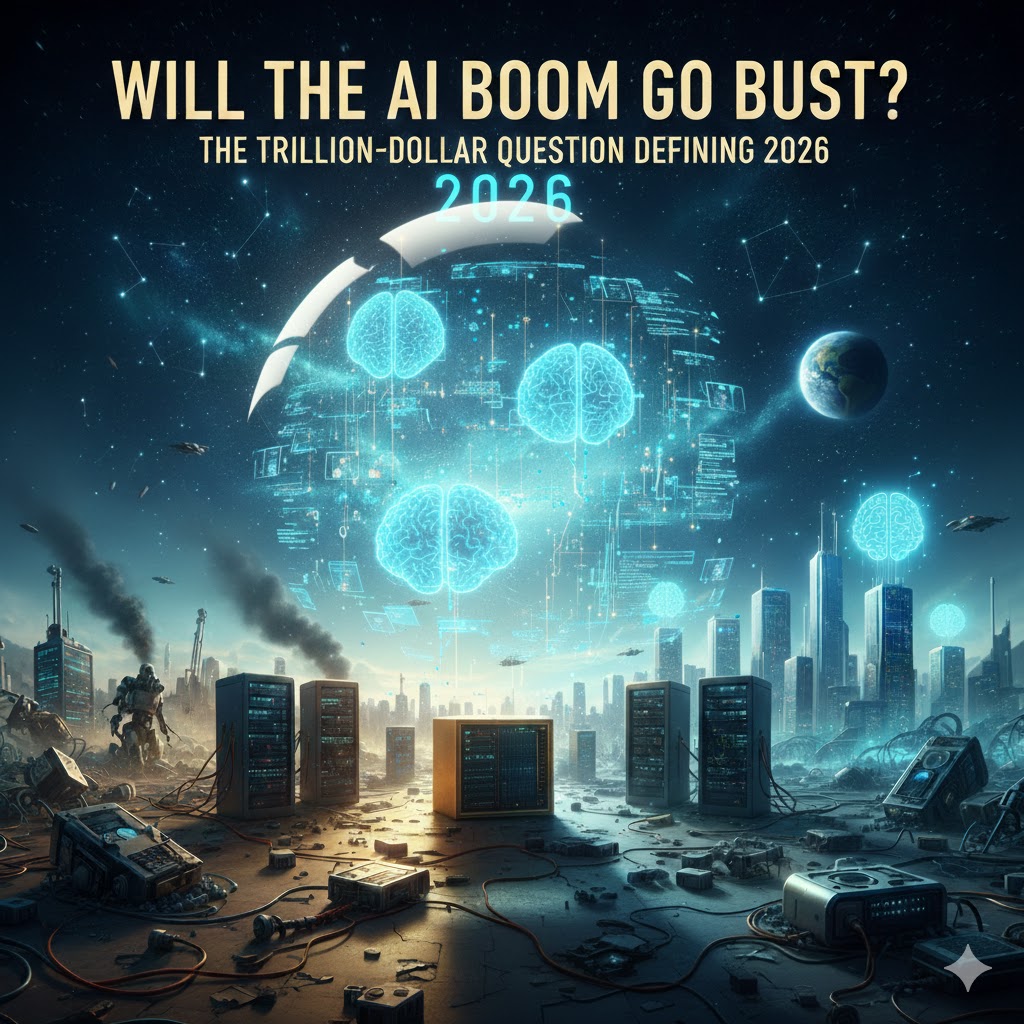
Will the AI Boom Go Bust? The Trillion-Dollar Question Defining 2026
🤖 The Gold Rush of the 21st Century
We are living through the single greatest technological expansion since the invention of the steam engine or the internet. From Generative AI writing complex software code to neural networks diagnosing rare cancers with superhuman accuracy, Artificial Intelligence has ceased to be science fiction. It has become the operating system of our modern world.
But as we stand in the first quarter of 2026, a whisper is turning into a roar among Silicon Valley's elite and Wall Street's most seasoned skeptics alike: Are we in a bubble? And if so, how loud will the pop be?
This isn't just about stock prices or shareholder value. It is a question about energy, geopolitics, and the fundamental question of whether the "intelligence" we are building is sustainable—or even profitable.
> "We are building the plane while flying it at supersonic speeds," remarks an executive at Nvidia who wished to remain anonymous. "The demand for compute is infinite, but power and silicon are finite. Something has to give."
📉 The Economics of Intelligence: The "CapEx Cliff"
To understand the "Bust" theory, you have to look at the balance sheets. In 2024 and 2025, the "Hyperscalers" (Microsoft, Google, Meta, Amazon) poured over $500 billion into AI infrastructure—purchasing H100/H200 chips, building liquid-cooled gigawatt-scale data centers, and upgrading fiber optics.
Yet, the revenue generated by these tools, while massive, scrapes only a fraction of that investment. We are seeing a "Return on Investment (ROI) Gap."
The "CapEx Cold War"
These companies are locked in a prisoner's dilemma. They are spending billions not because they *want* to, but because they *fear* being left behind.* The Sticker Shock: Building a single state-of-the-art training cluster now costs upwards of $10 billion. The hardware depreciates faster than a new car; a GPU bought in 2024 is practically obsolete by 2026 standards.
* The Risk: If AI applications (the "apps") don't become profitable enough to pay for the infrastructure (the "roads"), the entire ecosystem could collapse under its own weight.
* The History Lesson: We saw this with the Dot-com bubble of 2000. Miles of fiber optic cables were laid under the oceans, but consumer internet usage didn't catch up for another decade. Are GPU clusters the new dark fiber?
🔋 The Energy Bottleneck: Physics Bites Back
Perhaps the biggest threat to the AI boom isn't financial, but physical. AI models are hungry.
In 2025, the global AI compute sector consumed more electricity than the entire nation of Argentina. In 2026, it is on track to surpass Germany. We are technically running out of power. The legacy electrical grid cannot handle the load.
The Nuclear Pivot
This desperation has led to one of the strange pivots in industrial history: Tech companies becoming nuclear power operators. * **Microsoft**: Signed a historic deal to restart the **Three Mile Island** nuclear plant solely to power its East Coast data centers. * **Google & Amazon**: Are investing billions in **Small Modular Reactors (SMRs)**—miniature nuclear plants that can be deployed on-site next to server farms.This pivot highlights the severity of the bottleneck. If we cannot power the chips, we cannot scale the intelligence. And if we can't scale, the growth narrative stops dead.
🧠 Model Collapse: Is AI Eating Itself?
A more existential risk is a phenomenon researchers call "Model Collapse."
For the first decade of deep learning, models were trained on human data (books, articles, code written by people). But in 2026, the internet is flooded with AI-generated content. New models are increasingly being trained on data created by *other* AIs.
Imagine photocopying a photocopy a thousand times. Eventually, the image degrades into noise.
Researchers warn that if 2026 models are trained on the "synthetic slop" of 2025, we might hit a wall of diminishing returns. The "Intelligence Explosion" could flatten into an "Intelligence Stagnation," making the trillion-dollar investments worthless.
🌍 The Geopolitical Chessboard: The Silicon Curtain
AI is no longer just a commercial product; it is a weapon of national security. The world has fractured into two distinct technology spheres.
* US vs China: The chip export bans of 2024 have evolved into a full-scale "Compute Embargo." Controlling the supply of Blackwell chips is the modern equivalent of controlling oil reserves in the 1970s. The US government now treats an H200 GPU as a munition.
* Sovereign AI: Nations like Saudi Arabia, France (with Mistral), and India are building their own "Sovereign Clouds." They are buying thousands of GPUs to ensure their national data never leaves their borders and they aren't dependent on American tech giants. This fragments the market and increases inefficiency.
🔮 The Verdict: Boom, Bust, or Correction?
So, will it bust?
Most likely, we will see a "Great Correction," not a systemic crash.
1. The Wipeout: The thousands of "wrapper" startups that simply resell ChatGPT services with a thin UI will vanish overnight. They have no moat.
2. The Survivors: The companies building the "rails" (Chips, Cloud, Energy) and the companies solving specific, boring problems (Drug Discovery, Logistics Optimization) will survive.
As BBC Tech Correspondent Zoe Kleinman notes:
> "The internet didn't go away after the Dot-com crash. It just got boring, and then it got useful. AI is entering its 'boring' phase. And that's exactly when it becomes dangerous—and indispensable."
🏁 Conclusion: The Age of Utility
2026 will be the year of "Show Me the Money." Investors are done with promises of AGI (Artificial General Intelligence) and sci-fi dreams. They want to see profit margins. They want to see efficiency.
The AI Boom isn't over, but the "Free Money" era is. The winter is coming for the hype merchants, but the spring is just beginning for the builders.
❓ Frequently Asked Questions (FAQ)
Will AI replace my job in 2026?
**It depends.** The "replacement" narrative has shifted to "augmentation." You likely won't lose your job to an AI, but you will lose your job to *another human using AI*. The skill gap is widening. Proficiency in prompting and AI-workflow integration is now a baseline requirement for white-collar work.Is it too late to invest in AI?
**In the hype stocks? Yes.** The 100x gains of 2023-2024 are gone. The market is maturing. Smart money is moving into the "Pick and Shovel" plays: Energy companies powering the data centers, cooling companies preventing the chips from melting, and cybersecurity firms protecting the models.Is the AI energy usage destroying the planet?
**It's complicated.** Short term: Yes, carbon emissions from tech giants have spiked 30%. Long term: AI is optimizing existing grids and accelerating nuclear fusion research. It is a race between the carbon cost of training models and the carbon savings those models can discover.About the Author
Sarah Vance
Sarah Vance is a former Systems Architect turned senior technology journalist, bringing over 15 years of industry experience to Global Brief. Based in San Francisco, she specializes in decoding the post-silicon era, covering breakthrough developments in quantum computing, neural interfaces, and the ethical implications of Artificial General Intelligence (AGI). Her work has been cited by major tech think tanks, and she is a frequent speaker on the 'Human-in-the-Loop' philosophy. When not writing, Sarah is an amateur astronomer and an advocate for open-source AI safety protocols.
Global Brief Intel
Source:
Continue Reading
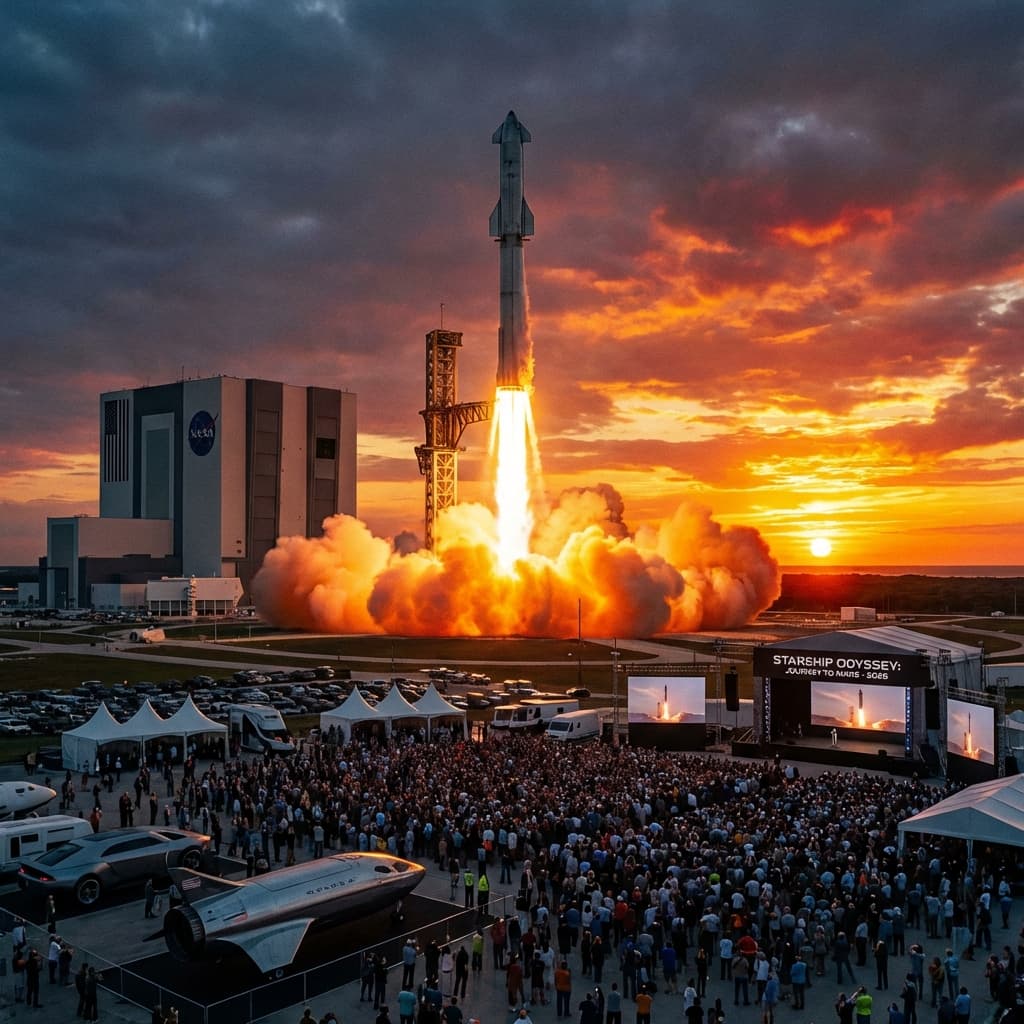
SpaceX Starship 'Odyssey' Departs for Mars: A New Era for Humanity Begins
The first civilian colony ship 'Odyssey' has successfully launched from Kennedy Space Center.

6G Networks in 2026: The Terahertz Revolution Changing Everything
6G trials in 2026 demonstrate speeds of 1 Terabit per second (100x faster than 5G).

The Loneliness Epidemic: Why 1 in 3 People Have an AI 'Partner' in 2026
A staggering 35% of adults under 30 now report having a 'significant emotional connection' with an AI entity, driven by advanced voice-mode capabilities.