
FIFA World Cup 2026: A $15 Billion Revolution Across Three Nations
🏟️ The Biggest Show on Earth: A Continental Challenge
In less than six months, the world will turn its eyes to North America for the most ambitious sporting event in human history. The 2026 FIFA World Cup is not just a tournament; it is a logistical behemoth spanning three sovereign nations (USA, Canada, Mexico), 16 host cities, and three time zones.
For the first time ever, the tournament has expanded from the traditional 32 teams to 48 national teams. This expansion means 104 matches will be played in just 39 days—a grueling schedule that turns logistics into a competitive sport of its own.
But beyond the goals, the glory, and the expanded bracket, a quiet revolution has taken place in the architecture and technology of the venues. This isn't just about adding seats; it's about the total digitization of the fan experience. The stadiums of 2026 are not just concrete bowls; they are giant, living computers.
> "This is not just about expanding capacity," says renowned architect Alejandro Aravena, a consultant on the project. "It is about creating smart stadiums that breathe, react, and engage with the digital world around them. In 2026, the building watches the game with you."
📊 The Economics of "United 2026": A Sustainable Model?
Hosting a World Cup has historically been a double-edged sword. The ghosts of tournaments past loom large: Brazil 2014 and South Africa 2010 left behind "white elephant" stadiums—billion-dollar structures essentially abandoned in the jungle, monuments to short-sighted waste.
However, the North American bid (United 2026) was built on a radically different foundation: Sustainability through Retrofitting.
1. Zero New Builds
Remarkably, every single stadium chosen for 2026 already existed. There are no bespoke venues built in the desert for a four-week lifespan. This has allowed the organizers to funnel capital into **infrastructure** rather than concrete.2. The $15 Billion Tech Upgrade
The massive $15 billion figure cited by economic analysts is strictly for renovation and connectivity. * **Connectivity**: Major venues like AT&T Stadium (Dallas) and MetLife Stadium (New Jersey) have installed private 6G networks to allow 80,000 fans to stream 4K video simultaneously without lag. * **Transit**: Cities like Los Angeles and Atlanta have accelerated public transit projects by a decade to meet the FIFA deadline, leaving a permanent legacy for residents.3. The Crown Jewel: SoFi Stadium (Los Angeles)
SoFi Stadium is the poster child for this new era. Already the most expensive stadium ever built ($5.5 billion), it underwent a further **$500 million retrofit** specifically for the World Cup. Its famous **"Infinity Screen" (Oculus)**—a dual-sided 4K video board weighing 2.2 million pounds—has been programmed to interact with fans' phones. If a player scores, your phone vibrates in sync with the stadium lights. It creates a unified, haptic crowd experience that has never been attempted at this scale.🇲🇽 Mexico's Historic Role: The Cathedral of Football
While the United States hosts the majority of the knockout games (including the Quarter-Finals onwards), Mexico provides the soul of the tournament.
The legendary Estadio Azteca in Mexico City will become the first stadium in history to host matches in three separate World Cups (1970, 1986, and now 2026). It is hallowed ground, where Pelé lifted the trophy and Maradona scored the "Hand of God."
To prepare, the Azteca is undergoing a massive, sensitive transformation. Architects are blending its iconic 1960s concrete brutalism with state-of-the-art flexible LED skins and modernized luxury suites. The challenge is preserving the intimidating acoustics—the famous "roar" of the Azteca—while adding the creature comforts expected by modern VIPs. It stands as a cathedral of football, bridging the analog past with the digital future.
🇨🇦 The Great Turf War: Canada's Agronomic Miracle
One of the biggest controversies leading up to 2026 has been the playing surface. FIFA mandates 100% natural grass for all World Cup matches due to injury risks and ball physics inconsistencies on artificial turf.
However, major host stadiums in Vancouver (BC Place) and Seattle (Lumen Field) utilize artificial turf due to the harsh climate and multi-use nature of the venues.
The Solution: "Hybrid Grow" Technology
A multi-million dollar agronomic miracle is currently underway. Engineers are installing a temporary natural grass pitch *over* the artificial one.
* This isn't just sod laid on concrete. It involves a complex system of UV grow lights, hydroponic root systems, and vacuum drainage installed indoors.
* For 40 days, these stadiums will become giant greenhouses, keeping the grass alive in environments where it naturally shouldn't exist. It is a triumph of agricultural engineering.
🤖 The AI Referee: The Death of Controversy?
2026 will also see the full, unbridled debut of Semi-Automated Offside Technology (SAOT) 2.0.
The older systems used in Qatar 2022 relied on 12 tracking cameras. The new 2026 system uses 50+ specialized cameras in every stadium, tracking 29 data points on every player's body, 50 times per second. It tracks the tip of a toe, the edge of a shoulder, and the exact moment the ball is struck.
> "The goal is zero delays," says Pierluigi Collina, FIFA's head of refereeing. "By the time the whistle blows, the AI has already made the decision within 300 milliseconds. The human referee is there to validate, not to calculate. We are removing the 'human error' and the 'parallax error' from the geometry of the game."
This system will also be displayed on the big screens instantly, showing fans a 3D animation of the decision, removing the agonizing 3-minute VAR waits that plagued previous tournaments.
✈️ The Travel Nightmare: A Logistical Warning
It's not all positive. Critics point out that the travel distances in 2026 are unprecedented.
In Qatar 2022, the furthest stadiums were 40 miles apart. In 2026, a team might play a group game in Seattle, fly 2,700 miles to Miami for the next, and then 2,000 miles to Mexico City.
This "Carbon Footprint" nightmare contradicts FIFA's carbon-neutral pledge. Teams will essentially be living on planes. To mitigate this, FIFA has implemented a "Cluster System" for the Group Stages, keeping teams within a specific region (West, Central, East) to minimize travel. However, once the Knockout Stage begins, the cross-continental jet-setting becomes unavoidable.
🏁 Conclusion: A Model for the Future
As the construction crews put the finishing touches on stadiums from Toronto to Guadalajara, the excitement is palpable. The 2026 World Cup promises to be more than a series of matches. It is a massive live experiment in continental cooperation, a showcase of architectural ingenuity, and a test of whether a mega-event can truly be sustainable.
For one month, North America will be the capital of the world. The world is watching, and for the first time, the stadiums are watching back.
❓ Frequently Asked Questions (FAQ)
Key Match Locations?
* **Opener:** Estadio Azteca, Mexico City. * **Final Match:** MetLife Stadium, New Jersey (New York). * **Semi-Finals:** AT&T Stadium (Dallas) and Mercedes-Benz Stadium (Atlanta).How do I get tickets?
Tickets operate on a lottery system via FIFA.com. Given the expanded capacity (most NFL stadiums hold 70,000+), there are more tickets available than ever before, but demand is expected to be 10x higher.Do I need a visa for all three countries?
**Yes.** This is a major logistical hurdle. Fans will need separate visas for the USA, Canada, and Mexico unless a special "World Cup Visa" agreement is reached, which relies on complex diplomatic negotiations currently underway.About the Author

Mike 'The Coach' Reynolds
Mike Reynolds, affectionately known as 'The Coach', brings a lifetime of sideline experience to his sports commentary. A former collegiate athlete and scout, Mike is a purist who champions the 'human element' in an increasingly data-driven game. He is a vocal critic of over-officiating via AI and a passionate storyteller of underdog victories. At Global Brief, Mike covers the cultural impact of major sporting events, the rise of eSports integration, and the evolving athlete training regimens of 2026. He believes stats tell the what, but people tell the why.
Global Brief Intel
Source:
Continue Reading
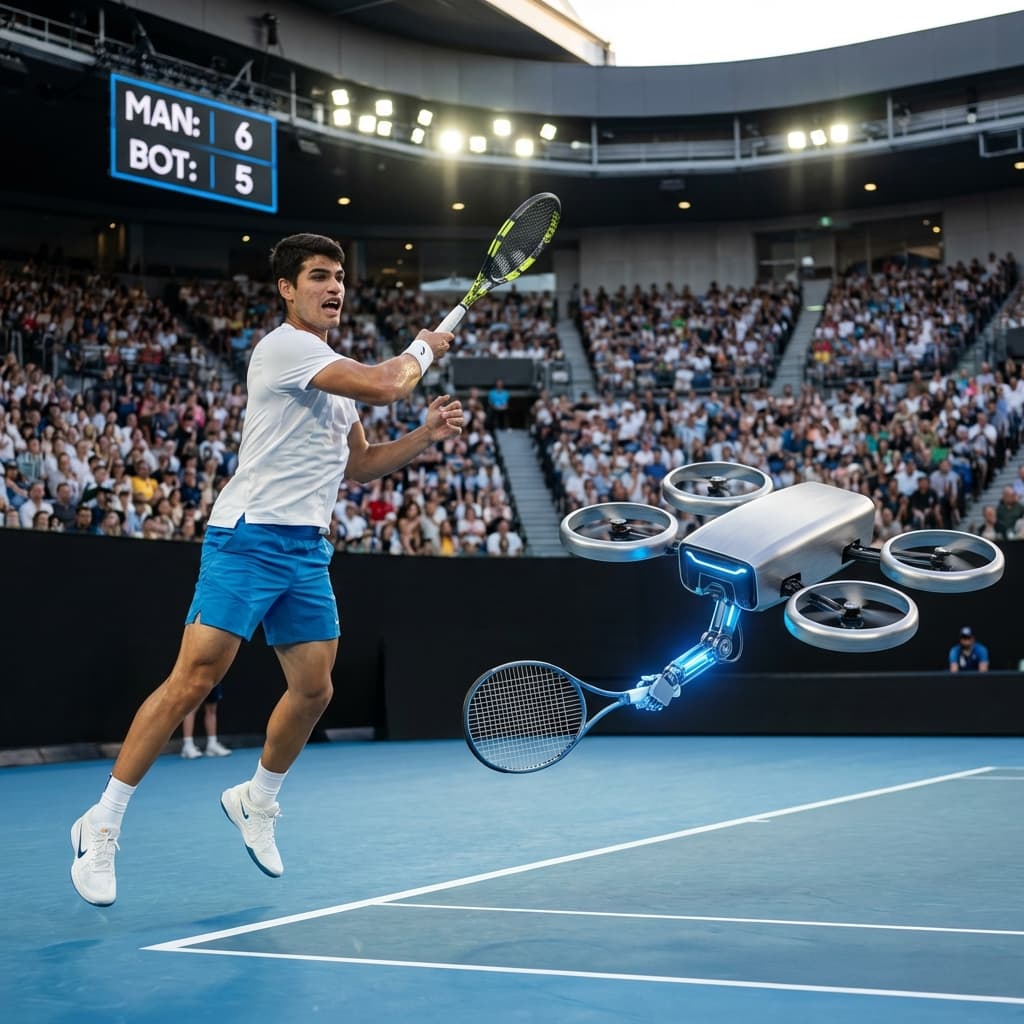
Alcaraz vs. Drone: Man Beats Machine at Australian Open
Carlos Alcaraz defeats the 'AceBot 3000' in a historic exhibition match at Rod Laver Arena.
Alcaraz Survives 5-Set Thriller Against Sinner to Reach Australian Open Final
Carlos Alcaraz defeated Jannik Sinner in a 5-hour, 12-minute marathon (6-4, 5-7, 7-6, 4-6, 7-5) to reach his first Australian Open final.

The Last Dance: Novak Djokovic Announces Official Retirement After Australian Open Exodus
It's the end of an era. Novak Djokovic, the most decorated male tennis player in history with 26 Grand Slams, has announced he will retire following his quarter-final exit at the 2026 Australian Open. The Serbian legend leaves behind a legacy that may never be surpassed.