
The Whistle Blows for Humans: AI Referees Take Over World Cup 2026
The Silent Stadium
It was the 89th minute of the Champions League Final in Paris. The ball struck the defender's hand in a blur of motion. In 2024, this would have triggered five minutes of chaos—players surrounding the referee, the agonizing wait for VAR, the slow-motion replays on the giant screen, the pundits arguing in the studio.
In 2026, nothing happened. Or rather, everything happened in a millisecond.
The captain's smartwatch buzzed: *"Penalty. Handball. Intentional. Grade 2."* The decision was relayed instantly to the spectators via their AR glasses. No argument. No drama. Just cold, algorithmic justice. The game restarted 12 seconds later.
This is the reality of "Project Whistle," FIFA's controversial initiative to fully automate officiating for the 2026 World Cup in North America. After decades of guarding the "human element" of the game, football's governing body has finally surrendered to the machines. And while the game has never been faster, purists are screaming into the void: has football lost its soul?
| Metric | Human Referee (2024) | Omni-Ref AI (2026) |
|---|---|---|
| Decision Time | 30-180 Seconds (VR) | < 1 Second |
| Accuracy | 94% (Elite Level) | 99.8% |
| Cost Per Match | $5,000 (Salary+Travel) | $500 (Server Cost) |
| Bias Risk | High (Unconscious) | Zero (Theoretically) |
The Technology: The "All-Seeing Eye"
The system, developed in partnership with Hawk-Eye and Google DeepMind, goes far beyond the "Semi-Automated Offside" of 2022. The new "Omni-Ref" system uses 56 ultra-high-definition cameras per stadium, tracking 29 points on every player's body at 500 frames per second.
But the real breakthrough is the "Intent Engine." By analyzing biomechanics, gaze direction, and velocity, the AI claims to determine *intent*. Did the player mean to trip his opponent? Was the handball accidental? The AI cross-references the movement against a database of 50 million historical fouls to calculate a probability score.
> "We aren't just tracking pixels anymore; we are modeling psychology," claims Dr. Aris Vlachopoulos, FIFA's Head of Innovation. "The AI has studied 50 years of footage. It knows a dive when it sees one. It knows a tactical foul better than any human eye. It doesn't get tired, it doesn't get intimidated by the home crowd, and it doesn't have a bad angle."
The Data: Speed Kills (The Boredom)
The statistics from the pilot leagues (MLS and Bundesliga) are hard to argue with. Game time is up. Dead ball time is down. The average match duration has dropped from 98 minutes to 92 minutes, yet the ball is in play for 15% longer. The flow of the game is relentless.
However, the "Error Rate" is the metric FIFA parades most proudly. Human referees, even at the elite Premier League level, have an accuracy rating of about 93-95%. The Omni-Ref system sits at 99.8%.
"You wouldn't accept a bank calculator that gets 5% of sums wrong," argues Gianni Infantino, FIFA President, who has staked his legacy on this rollout. "Why should we accept it in a multi-billion dollar sport? This is about integrity."
The Human Toll: Unemployed in Black
For the referees themselves, 2026 is the end of an era. The "Field Marshall" role has been reduced to a ceremonial figurehead—essentially a customer service agent who explains the AI's decisions to the captains. They no longer carry whistles; they carry tablets.
"I spent 20 years training for this," says Mark Clattenburg, a retired Premier League referee now leading the 'Save Our Refs' campaign. "The pressure, the intuition, the management of tempers—that's part of the theatre. A robot doesn't understand the flow of a game. It doesn't understand *mercy*. Sometimes, a yellow card is about calming the game down, not just punishing a foul. The AI doesn't understand context."
The "Sterile" Game?
This concept of "mercy" or "flow" is central to the fan backlash. There is a growing feeling that the game is becoming *too* perfect, too clinical.
In a recent match between Real Madrid and Bayern Munich, the AI awarded a penalty for a shirt pull that lasted 0.2 seconds—invisible to the naked eye, but clear to the cameras. Technically correct? Yes. In the spirit of the game? Debatable.
Fans in the "Ultras" forums are rebelling. Banners reading "AGAINST MODERN FOOTBALL, AGAINST MACHINE FOOTBALL" are becoming common sights in stadiums across Europe. There is a fear that by sanitizing every mistake, we are removing the friction that makes sports compelling. We love to hate the referee. Can you hate an algorithm?
The Betting Industrial Complex
Skeptics point to another beneficiary: the gambling industry. With the removal of human error (and the potential for match-fixing), the betting markets have exploded. "Micro-betting"—wagering on the outcome of the next 10 seconds—is now the standard.
"certainty is a product," explains financial analyst Sarah Wu. "When you remove the ambiguity of the referee, you turn the sport into a tradable asset class. The AI has made football 'safe' for Wall Street style algorithms to bet on play-by-play action."
The Looming Hack: When the Server Decides the Champion
But the darkest cloud hanging over the 2026 World Cup is not boredom; it is security. In a world where the referee is a piece of software, the referee can be hacked.
Cybersecurity experts warn that the "Omni-Ref" servers are now the single most valuable target in the sporting world. You don't need to bribe a corrupted official in a parking lot anymore; you just need a zero-day exploit.
"Imagine a malware that subtly adjusts the 'foul threshold' by 5% for one team," says Kaelen Reed, a white-hat hacker who previously exposed vulnerabilities in Tesla's autopilot. "It wouldn't be obvious. It would just look like 'strict officiating.' But over 90 minutes, that extra 5% of leniency is the difference between winning and losing. If I'm a syndicate betting $100 million on Brazil, hacking that server is a business expense."
In 2025, a scandal rocked the eSports world when it was revealed that an AI umpire had been compromised by a betting ring. The code was tweaked to favor 'Comeback Mechanics,' ensuring close games to boost viewership. FIFA insists their system is "air-gapped" and unhackable, but in the age of quantum computing, "unhackable" is a temporary state.
If the World Cup Final is decided by a glitch—or worse, a hack—it won't just be a sporting tragedy. It will be the end of trust in automated governance. The whistle might have been taken from the human mouth, but the potential for corruption hasn't disappeared; it has just moved from the pitch to the server room.
Future Outlook: The Player Upgrade
As officiating evolves, so must the players. Gone are the days of the "Dark Arts"—the subtle shirt tugs, the tactical dives, the time-wasting near the corner flag. You cannot trick a LiDAR sensor. You cannot argue with a cloud server.
Coaches are already adapting. Academies like La Masia and Cobham are training players to move differently. They are taught to keep their hands strictly behind their backs in the box, to run with "AI-compliant" gaits that minimize the risk of accidental contact. We are breeding a new generation of players designed not to beat the opponent, but to satisfy the code.
2030: The End of the Linesman?
The next phase is already in development: robotic linesmen. Boston Dynamics has reportedly prototyped a bipedal droid capable of keeping pace with Kylian Mbappé while carrying a flag. If Omni-Ref is the brain, these will be the body.
When the first whistle blows at the Azteca Stadium in June 2026, it won't be blown by a human lips. It will be a digital chirp, synchronized to 80,000 smartwatches. The game will be fairer. It will be faster. It will be technically perfect. But as we watch strict perfection unfold on the pitch, we might find ourselves missing the chaotic, unjust, human mess that football used to be.
About the Author

Mike 'The Coach' Reynolds
Mike Reynolds, affectionately known as 'The Coach', brings a lifetime of sideline experience to his sports commentary. A former collegiate athlete and scout, Mike is a purist who champions the 'human element' in an increasingly data-driven game. He is a vocal critic of over-officiating via AI and a passionate storyteller of underdog victories. At Global Brief, Mike covers the cultural impact of major sporting events, the rise of eSports integration, and the evolving athlete training regimens of 2026. He believes stats tell the what, but people tell the why.
Global Brief Intel
Source:
Continue Reading
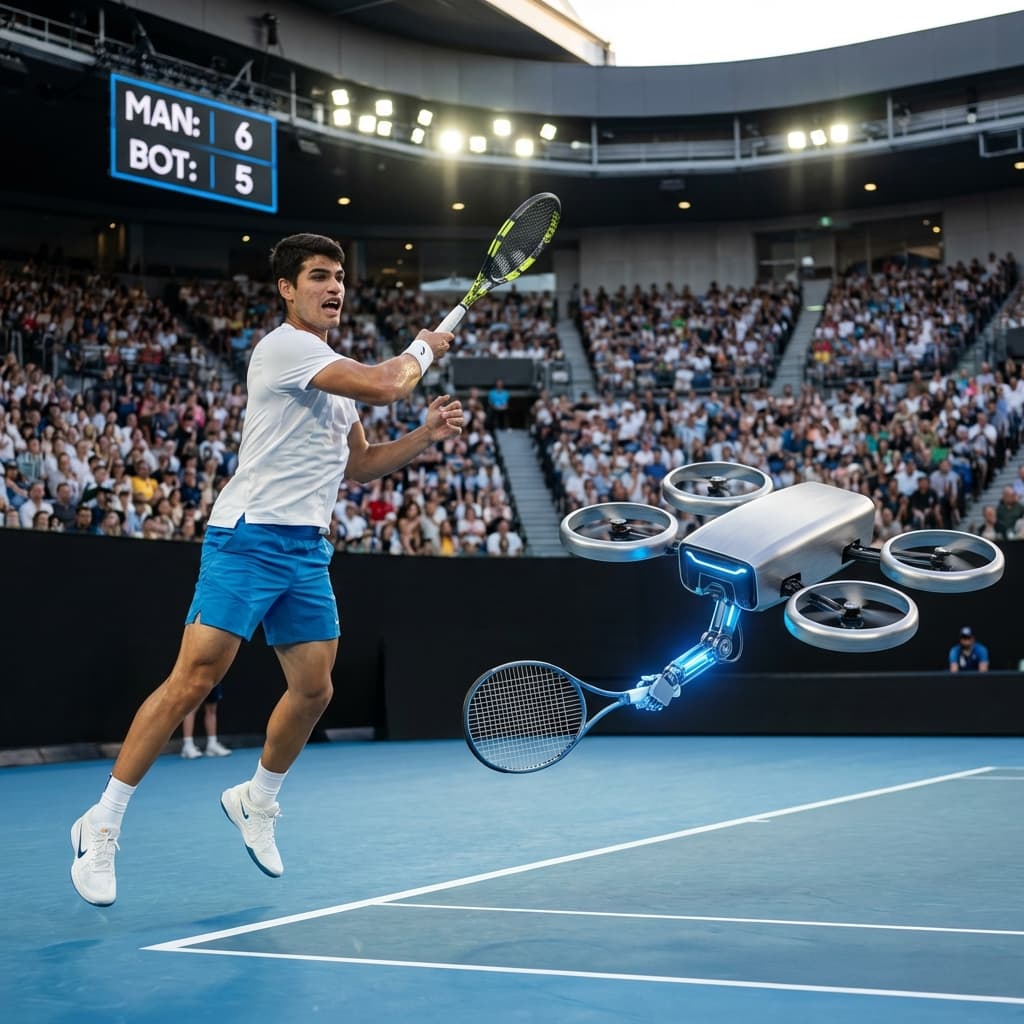
Alcaraz vs. Drone: Man Beats Machine at Australian Open
Carlos Alcaraz defeats the 'AceBot 3000' in a historic exhibition match at Rod Laver Arena.
Alcaraz Survives 5-Set Thriller Against Sinner to Reach Australian Open Final
Carlos Alcaraz defeated Jannik Sinner in a 5-hour, 12-minute marathon (6-4, 5-7, 7-6, 4-6, 7-5) to reach his first Australian Open final.

The Last Dance: Novak Djokovic Announces Official Retirement After Australian Open Exodus
It's the end of an era. Novak Djokovic, the most decorated male tennis player in history with 26 Grand Slams, has announced he will retire following his quarter-final exit at the 2026 Australian Open. The Serbian legend leaves behind a legacy that may never be surpassed.